


How Much Should I Eat?
This is probably one of the most frequently asked questions I receive as a Registered Dietitian. Although it’s often intended as a simple question, it’s a not-so-simple answer (although perhaps it could be, if diet culture weren’t complicating everything!).
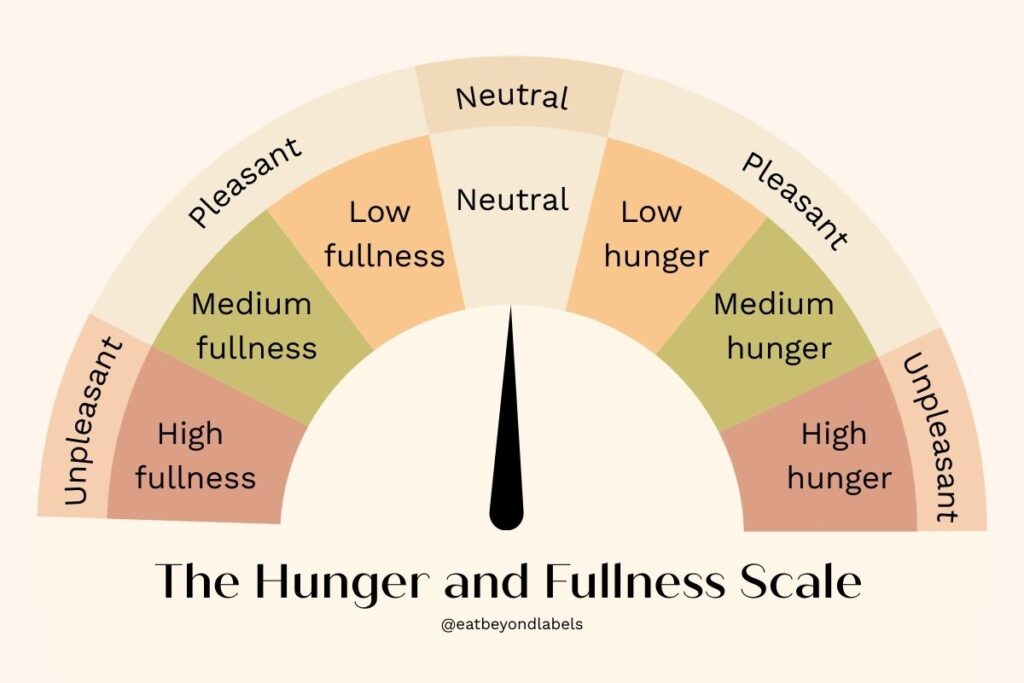
This blog will walk you through step-by-step how to use the Hunger and Fullness scale, a useful tool in the Intuitive Eating approach, to help guide how much food your body needs, and when it’s time to eat!
I’m Glad You’re Here!
I’m Christy, a Registered Dietitian passionate about helping folks explore the stories we tell ourselves around food and gently reconnect with the wisdom of our own bodies. I especially enjoy working with queer and trans folks, neurodivergent individuals, and anyone who’s felt sidelined by mainstream food and diet advice.
Disclaimer: While I am a Registered Dietitian (also known as “Registered Dietitian Nutritionist”), I am not your Registered Dietitian or familiar with your specific medical history. This content is for educational purposes only and is not professional or medical advice.
Relearning to Trust Your Body
In nature, plants rely on natural signals to know when to draw water, grow new leaves, and rest. Our bodies carry similar wisdom about when, what, and how much to eat—that is, if we know how to listen and allow enough consistency for that signal to be heard.
Many of us have become disconnected from these internal senses and cues. This disconnection isn’t a personal failing. It can come from lived experiences, trauma, diet culture, or simply living in a fast-paced, productivity-focused world.
Dieting Fuels Body Disconnection
Chronic dieting teaches us to ignore internal senses of hunger and rely on external rules (calorie counts, fasting clocks, “good” vs. “bad” foods). This can create distrust between mind and body, and blunted hunger and fullness cues. The good news is that with time, support, and intention, we can learn to get out of our heads and back into our bodies.
Understanding Interoception and Body-led Awareness
Interoception is our ability to sense internal bodily cues such as hunger, thirst, or the need to use the bathroom. For many people with a history of trauma, neurodivergence (like ADHD or autism), eating disorders, or anxiety (just to name a few), interoceptive awareness can be muted, or just plain confusing!
A quick note: While this blog will discuss some tips to rebuild interoceptive awareness, I highly recommend working with a compassionate care team that includes a registered dietitian and/or therapist if you’re using a GLP-1 medication, recovering from an eating disorder, or experiencing another reason that makes interoception challenging. Click here to learn more about how I can support your health journey.
The good news: hunger cues are resilient and can return with consistent nourishment and care. The hunger and fullness scale (below) is an important part of the Intuitive Eating framework, which guides us to learn how our body uniquely communicates hunger and fullness.
How to Use the Hunger and Fullness Scale
Hunger and fullness exist on a continuum or range that looks different for everyone. The goal isn’t to be eating within a “perfect” range, but rather to familiarize ourselves with our bodies, habits, and patterns. This blog specifically explores physical hunger and fullness cues. Want to understand hunger that isn’t about your stomach? Click to learn more.
High Hunger
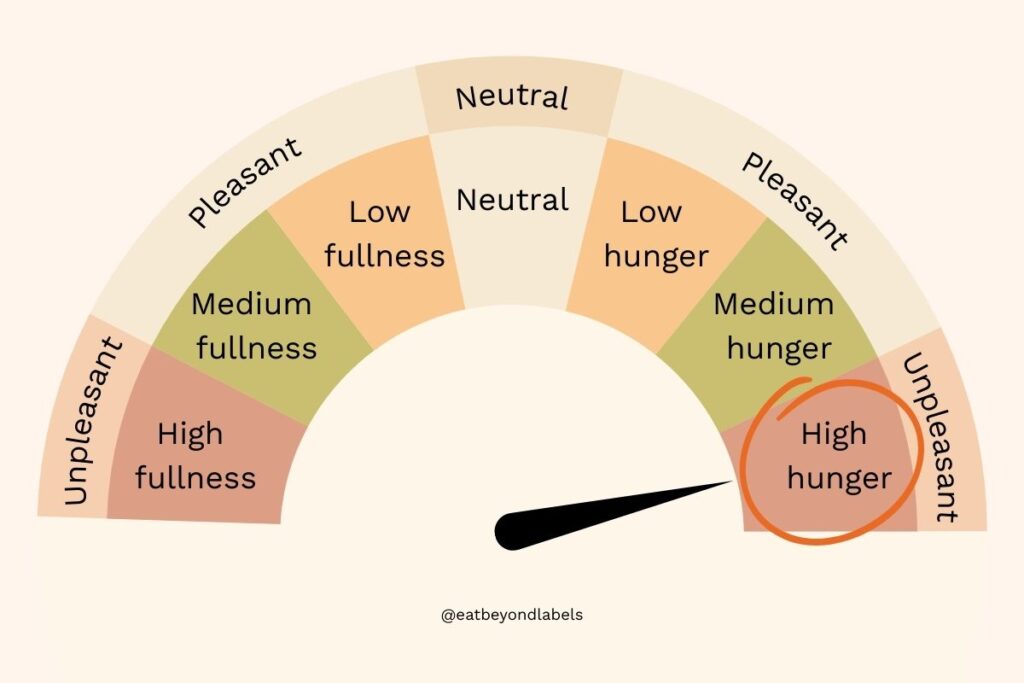
High hunger can feel different for everyone. It is often present when we are experiencing low blood sugar- a potentially serious condition!
Understandably, our bodies will send us strong (or “loud”) signals to get our attention and protect us. Common symptoms of high hunger include lightheadedness, shakiness, irritability, headaches, difficulty with decision-making, and an urgent need to eat. Symptoms of high hunger or low blood sugar can also overlap with anxiety or result in mood changes (think: HANGRY!) This can be uncomfortable and overwhelming, and often happens when hunger has been ignored for too long.
Medium Hunger
Medium hunger is also described as “meal hungry.” Medium hunger is typically present a few hours after a meal.

You might notice your stomach growling, a noticeable interest in food, energy dipping, and maybe a slight difficulty focusing. Medium hunger is comfortable and lacks urgency, making it a “polite” hunger. If you’re feeling medium hungry, it’s usually an ideal time to eat a full meal to prevent high hunger later.
Low Hunger
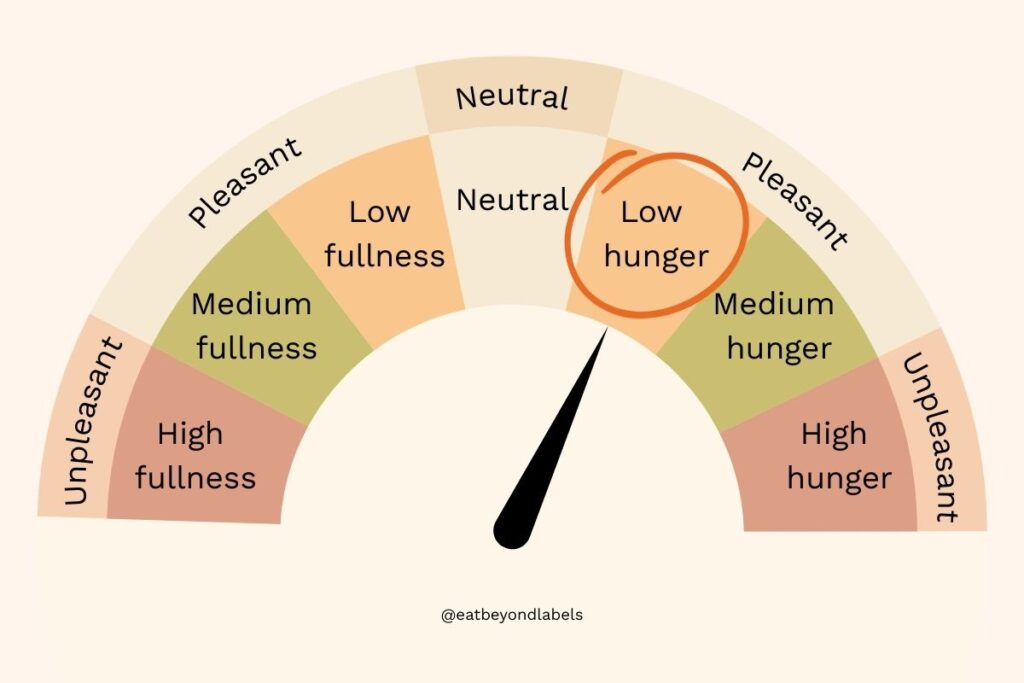
Low hunger is also known as “Snack Hungry.” This might show up as mild thoughts about food or more interest in food (often villainized as the “food noise”).
Low hunger can feel neutral or pleasant. You might notice certain foods seem appealing, but you aren’t experiencing strong body cues yet. Eating a snack here can help prevent future discomfort and support sustained energy. If you notice energy dips in the afternoon between lunch and dinner, you might be experiencing low hunger. Working with a dietitian can help you better understand how nutrition can support stable energy throughout the day.
Neutral
Neutral means no feelings of hunger or fullness. Neutral typically doesn’t feel pleasant or unpleasant – again, it’s neutral!
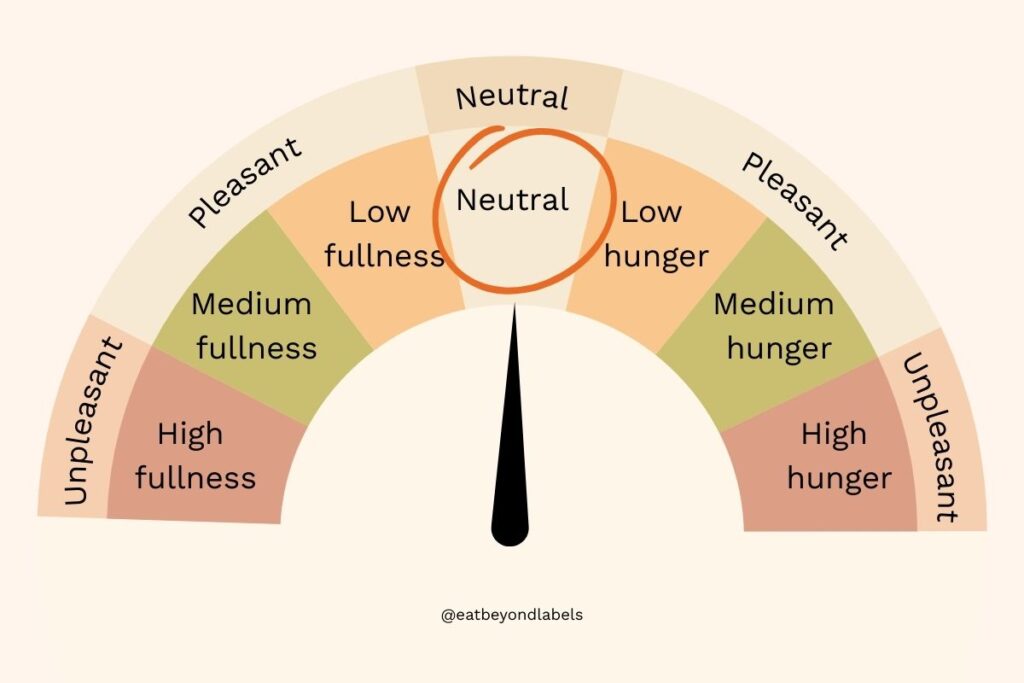
It often happens an hour or two after eating a balanced meal. Some folks may eat here for practical or social reasons—this is normal and okay. You might notice that nothing sounds appealing or appetizing if you are experiencing this level. Feeling “neutral” is different from not experiencing hunger and fullness cues, and working with a health care provider to improve interoception is often helpful if cues are truly absent.
Low Fullness

Low fullness typically involves a sense of having eaten, but not feeling quite satisfied.
This may occur partway through eating a meal, when you notice you may need a bit more to feel satisfied. It also may occur shortly after eating a meal, after your stomach has had time to digest. Low fullness typically feels neutral or pleasant.
Medium Fullness
Medium fullness means feeling satisfied, comfortably full, and generally not thinking about food anymore. It is often a pleasant stopping point for many meals.
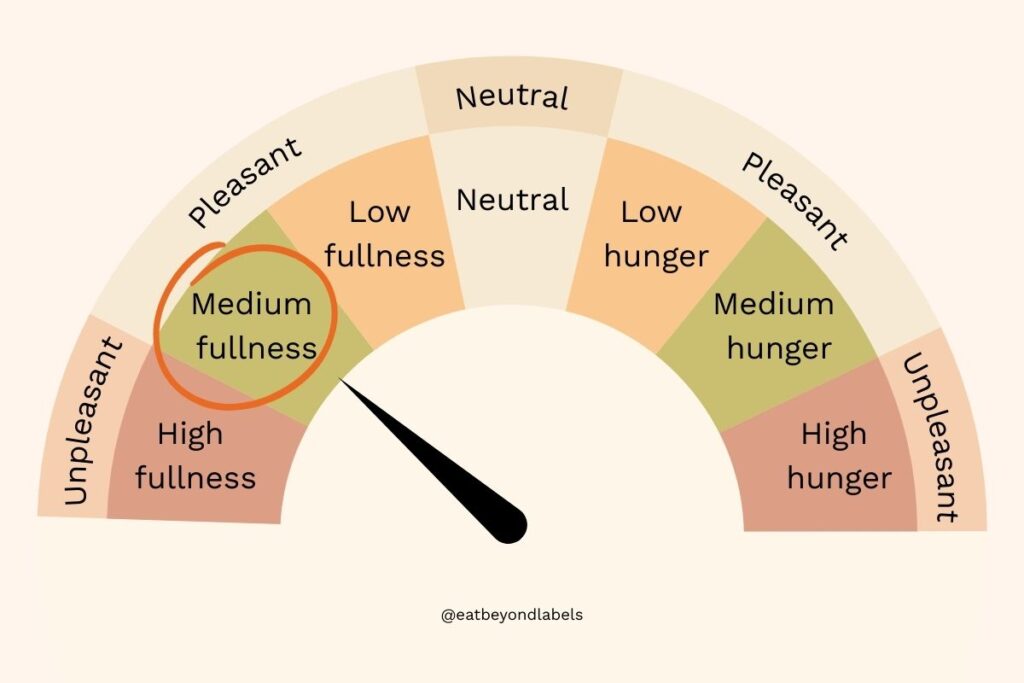
There are many reasons why we, as humans, may continue to eat past comfortable fullness. If you choose to continue eating after comfortable fullness, it might be helpful to check in and notice any reasons why, including internal or external factors.
High Fullness

High fullness typically includes feeling stuffed, sluggish, or painfully full. It is often physically uncomfortable.
High fullness happens to everyone occasionally and isn’t something to feel guilty over. If you notice a pattern or high frequency of eating to high fullness, or overeating, it may be a helpful opportunity to check in and work with a dietitian for additional support.
There’s No Right or Wrong Way
Let this be your friendly reminder that these levels aren’t “good” or “bad.” As human beings, it’s normal to experience each of these different levels as we go through life. Checking in and noticing what level you’re at can help you recognize patterns, prevent discomfort, and promote steady energy and blood sugar regulation.
So, How Much Should I Be Eating?
Despite what diet media or calorie calculators may say, there is no magic number, portion, or formula to know exactly how much we need to eat. Broadly speaking, we can get most of our nutrition needs met and support our blood sugar by eating within the “low-medium hunger” to “low-medium fullness” ranges on the Hunger and Fullness Scale. Of course, we may adjust depending on what we have planned for the day and how often we expect to have food and eating opportunities available. Read below for more tips to support steady energy and body communication.
Listen to Hunger at a Whisper, not a Roar
As you were reading through, which of these levels were easiest for you to identify? Which ones were the most challenging? I find that low hunger, neutral, and low fullness are often the most challenging for folks to identify. When we learn to listen to our signals when they’re at a whisper, they won’t need to “yell” to get our attention.
Gentle Tips for Supporting Hunger and Fullness Cues
These are not rules, but rather gentle invitations to help rebuild trust and experience more comfort with your body.
- Check In Regularly: Try pausing a few times a day to ask: “Where am I on the hunger/fullness scale?” Offer curiosity, not judgment.
- Eat Consistently: Aim for regularly timed meals or snacks, especially if you’re rebuilding hunger cues or have energy fluctuations. This helps stabilize blood sugar, mood, and focus.
- Normalize Non-Physical Hunger: It’s okay to eat for reasons beyond physical hunger. You are allowed to eat for joy, emotion, convenience, or celebration.
- Add Instead of Restricting: Instead of focusing on what to avoid, ask what you can add to feel more nourished, satisfied, or energized.
- Work with Support: It may be helpful to work with a dietitian to determine if improving the balance and composition of your meals or snacks can help you feel satiated and comfortable. If tuning into hunger is hard, you’re not alone! A non-diet RD can offer support without judgment. Learn how I can support your journey here.
Hunger is not just a bodily function; it’s a relationship. The more you listen to your body without judgment, the more clearly you will hear your body speak. You deserve to feel safe, nourished, and at peace with food—no matter your size, background, or identity.

Christy is a Registered Dietitian Nutritionist and Certified Diabetes Care and Education Specialist who is dedicated to support folks with metabolic health and disordered eating recovery. They provide inclusive, evidence-based nutrition support for folks with neurodivergent, LGBTQ+, and multicultural identities. Christy has lived in several Asian countries and speaks conversational Cantonese.


View comments
+ Leave a comment